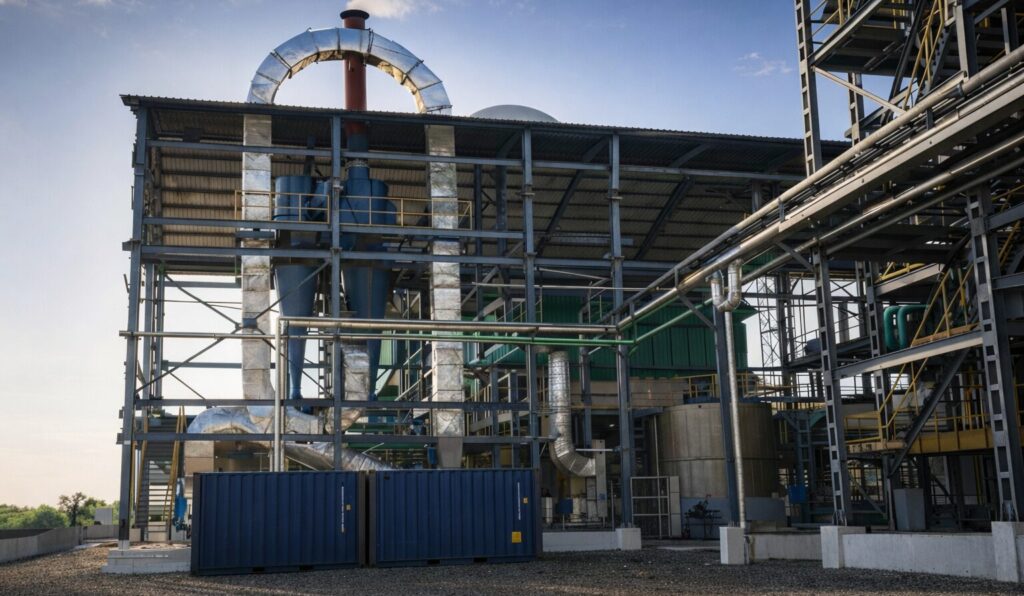
What is a DDGS / DWGS Dryer?
A DDGS dryer is an industrial dryer designed specifically to handle the characteristics of distillery by-products—especially DWGS, which contains high moisture and tends to be sticky due to the presence of solubles. The purpose of the dryer is to reduce moisture to a level where the product becomes stable, storable, and economically transportable, while maintaining nutritional quality for animal feed.
DDGS and DWGS meaning
- DWGS full form: Distillers Wet Grains with Solubles
DWGS is a wet, high-moisture by-product produced during ethanol manufacturing. Because the moisture is high, DWGS is difficult to store for long periods and costly to transport over long distances.
- DDGS full form: Distillers Dried Grains with Solubles
DDGS is the dried form of DWGS. By reducing moisture to a controlled level, DDGS becomes suitable for longer shelf life, safer handling, and wider distribution—often including export markets.
Typical moisture context (practical ranges):
- DWGS inlet moisture is commonly in the high-moisture range (often ~65–75%, depending on process and dewatering efficiency).
- DDGS outlet moisture is typically controlled around 8–12% (depending on market requirement and storage/transport needs).
Why DWGS must be dried (storage, transport, quality)
DWGS drying is not only about removing water—it’s about making the product commercially viable and quality-consistent:
- Storage stability: High moisture increases the risk of spoilage and reduces shelf life.
- Transport economics: Wet material increases weight and freight cost; drying improves logistics efficiency.
- Handling & flowability: Drying reduces stickiness and improves flow, reducing material handling issues.
- Feed quality consistency: Controlled drying helps deliver a more uniform product in terms of moisture and appearance.
- Export suitability: Export markets often require consistent moisture and better product appearance; a DDGS drying system is a key step to meet those expectations.
In ethanol plants where DDGS is a strategic revenue stream, a DDGS/DWGS ring dryer is typically selected to support high throughput with stable product quality, especially where the process demands reliable moisture control and consistent, free-flowing final product.
DDGS Drying Challenges
Drying DWGS/DDGS feed is more complex than drying many other industrial materials because the feed is wet, sticky, fibrous, and often includes solubles (syrup) that increase tackiness. If the drying system is not engineered specifically for these characteristics, plants commonly face unstable moisture, poor product appearance, and frequent operational issues.
Sticky, fibrous nature and solubles mixing issues
DWGS typically contains a mix of wet grains and solubles that can behave like a sticky mass during heating and drying. Key challenges include:
- High stickiness due to solubles and fine particles, which promotes clumping during drying
- Fibrous structure that resists uniform moisture removal and can form aggregates
- Non-uniform feed consistency, especially when wet cake and solubles are not perfectly blended
- Poor dispersibility in conventional dryers, which reduces air–solid contact efficiency
- Material build-up on contact surfaces if the drying environment allows wet particles to adhere
- Moisture gradients within the same batch (some particles overdried, others underdried)
Why it matters: When feed does not disperse properly, the dryer cannot maintain a stable drying profile. Plants see higher variability in outlet moisture and inconsistent final product.
Quality risks during drying (color, lumps, overheating, ADIN)
If drying is slow or uneven, the product may experience overheating at local points. This directly affects appearance and nutritional quality.
Common quality risks include:
- Dark product color caused by excessive heat exposure and longer residence time
- Lumps and agglomerates due to sticky feed partially drying on the surface while the core remains wet
- Scorching / burning spots in systems where hot zones exist or residence time is high
- Inconsistent final moisture, leading to either:
- Over-dried product (dusty, more fines, potential nutrient damage), or
- Under-dried product (storage instability and spoilage risk)
- Protein heat damage, which can reduce nutritional value and animal feed performance
- Higher ADIN values (Acid Detergent Insoluble Nitrogen), which is widely used as an indicator of heat damage and reduced protein availability
Why it matters: For DDGS markets—especially premium/export buyers—consistent moisture, lighter color, fewer lumps, and lower heat damage indicators are key differentiators. Drying challenges directly impact pricing, customer acceptance, and repeat orders.
A DDGS drying system must therefore be designed to
(1) disperse sticky feed effectively,
(2) avoid local overheating, and
(3) maintain tight moisture control under continuous industrial operation.
DDGS Ring Dryer Working Principle
A DDGS ring dryer is designed to dry sticky, high-moisture DWGS by maximizing air–solid contact, controlling residence time, and using an internal classification + recycle loop so wet/heavier particles stay longer while dry/fine particles exit faster. This approach helps achieve uniform vacuum drying and stable final moisture without exposing the product to long, high-temperature residence that can cause darkening or nutrient damage.
Step-by-step working of DDGS ring dryer
- Feed preparation and controlled feeding
- DWGS (wet grains with solubles) is fed continuously through a controlled feeder/conveyor.
- If the process uses recycle mixing, a portion of dried product may be blended back to improve flowability and stabilize outlet moisture.
- Disintegration / dispersion
- The wet feed enters a disintegrator (or disperser) where it is broken into smaller particles.
- This step is critical for DDGS because sticky feed must be opened and dispersed to prevent clumps and to expose moisture for rapid evaporation.
- High-velocity hot air contact
- Heated air is introduced to create strong under vacuum transport and intense air–solid contact.
- The high-velocity airflow increases the heat and mass transfer rate, allowing quick moisture removal from fine particles.
- Rapid moisture evaporation
- Moisture evaporates quickly due to:
- high air velocity (better contact),
- dispersed particles (higher surface area),
- controlled residence time (avoids overheating).
- The goal is fast drying without developing hot spots that can darken or burn product.
- Centrifugal classification (ring/classifier zone)
- The air–solid stream passes through a ring duct / centrifugal classifier section.
- Here, particles are separated based on size and moisture:
- Fine / drier particles remain entrained in air and move forward.
- Heavier / wetter particles are rejected and sent back into the drying loop.
- Selective recycle loop (residence time control)
- Recycled wet particles re-enter the high-velocity zone for further dispersion and drying.
- This creates a natural “self-balancing” mechanism:
- Wet material stays longer,
- Dry material exits sooner,
- Final moisture becomes easier to control.
- Product separation and collection
- Dried product is separated from air using high-efficiency cyclones and/or a bag filter system.
- Collected DDGS is discharged through a controlled outlet, then conveyed to cooling/storage as required.
- Air handling and dust control
- Exhaust air is handled by an induced draft / exhaust fan.
- Dust control is achieved using properly sized cyclones and bag filters to meet site emission requirements.
Result: A consistent DDGS product with improved flowability, fewer lumps, better appearance, and stable moisture—suitable for storage and export handling.
DDGS Dryer Diagram (Process Flow Explained)
Use this section directly under your process flow image so Google and users can understand the system layout. The diagram should show both material flow and airflow clearly.
Process flow diagram — component-wise explanation
- 1) Feed section (DWGS inlet)
- Receives wet grains with solubles from the dewatering section.
- Ensures steady feed rate to maintain stable outlet moisture.
- 2) Disintegrator / disperser
- Breaks wet, sticky feed into smaller particles to prevent clumping.
- Improves drying efficiency by increasing exposed surface area.
- 3) Air heater / hot air generator
- Generates heated drying air based on available heating media (steam/thermic fluid/solid fuel/biomass/biogas).
- Air temperature is selected based on feed moisture, capacity, and product quality requirements.
- 4) Ring duct / classifier zone
- Creates centrifugal classification to separate wet/heavy particles from dry/fine particles.
- Drives the recycle loop that controls residence time and final moisture.
- 5) Cyclone separator(s)
- Separates dried DDGS particles from the air stream using centrifugal force.
- Reduces dust load before air moves to secondary filtration.
- 6) Bag filter (final dust collection)
- Captures fine particles that escape cyclones.
- Helps meet emission norms and improves product recovery.
- 7) Product discharge
- Dried DDGS is discharged to downstream conveying, cooling, and storage.
- Discharge design helps maintain a free-flowing product without re-wetting.
- 8) Exhaust / ID fan
- Maintains airflow and system pressure balance.
- Supports stable pneumatic transport and consistent drying performance.
How to label the diagram for better clarity (recommended)
- Mark Material Flow arrows (DWGS → disintegrator → ring duct → cyclones → product discharge)
- Mark Air Flow arrows (heater → drying zone → cyclones → bag filter → exhaust fan)
- Add one small note near the classifier:
- “Wet/heavy particles recycle for additional drying; dry/fine particles exit”
This diagram explanation helps users searching for “ddgs dryer diagram” and supports ranking for “ddgs dryer working principle” by making the process easy to understand and easy to scan.
Comparison — Ring Dryer vs Rotary Bundle Dryer (DDGS Application)
Below is a DDGS-focused comparison to help ethanol producers evaluate drying performance, product quality outcomes, and operational suitability. Actual performance depends on feed moisture, capacity, utilities, and plant integration, but the table reflects typical operational behavior for DDGS/DWGS drying.
Comparison table (DDGS application)
| Parameter |
DDGS Ring Dryer |
Rotary Bundle Dryer |
| Drying approach |
High-velocity vacuum air drying with classification & recycle |
Long-residence drum drying |
| ADIN value (heat damage indicator) |
Very Low |
Very High |
| Typical residence time |
Short and controlled (minutes) |
Long (tens of minutes) |
| Moisture control |
Easier due to selective recycle loop |
More difficult due to long exposure & variability |
| Product burning / scorching risk |
Lower (controlled exposure) |
Higher risk in hot zones / long residence |
| Product color consistency |
Typically better (lighter, more uniform) |
Often darker; variability common |
| Lumps / agglomeration |
Lower tendency (dispersion + recycle) |
Higher tendency with sticky feed |
| Suitability for sticky DDGS feed |
Designed specifically for sticky/fibrous feed |
Can face sticking and quality issues |
| Maintenance profile |
Generally lower mechanical load vs drum systems |
Higher due to drum, trunnions, drives |
| Footprint / civil requirement |
Compact footprint |
Large footprint + heavier foundations |
| Export suitability (quality stability) |
Strong when engineered for DDGS quality |
Often limited due to color/lumps/variability |
Due to lower heat damage (low ADIN tendency), lighter color, and better moisture consistency, DDGS produced using a ring dryer is generally positioned as a more premium-grade product than rotary-dried DDGS. This helps improve market acceptance, reduces buyer quality complaints, and supports better realizations where export or consistent feed quality specifications
DDGS Dryer Plant Configuration & Integration
A DDGS dryer plant is typically supplied as a complete system covering feed handling, drying, separation, and dust control. For stable performance, the overall configuration must match plant capacity, inlet moisture, target outlet moisture, and available utilities. In DDGS applications, special attention is given to feed dispersion, residence time control, and dust collection to maintain consistent quality.
Typical DDGS dryer system components
Feed handling and conditioning
- Feed hopper / feed conveyor / screw feeder for controlled and continuous feeding
- Optional recycle mixing (if required) to improve flowability and stabilize final moisture
- Feed transfer chutes designed to reduce bridging and material build-up
Drying and classification
- Disintegrator / disperser to break wet sticky feed into smaller particles
- Ring duct / classifier zone to separate dry/fine particles from wet/heavy particles
- Selective recycle path that returns wet/heavy particles back to the drying loop
Product separation and dust control
- Primary cyclone separator(s) for bulk product separation
- Secondary cyclone and/or bag filter for fine dust capture and emission compliance
- Rotary airlock / discharge system for controlled product discharge
Air handling and controls
- Air heater / hot air generator (selected based on heating media)
- Exhaust / induced draft fan to maintain stable airflow and system pressure
- Ducting, dampers, and instrumentation to stabilize operating conditions
- PLC-based control panel (recommended) for consistent moisture control and safe operation
Integration points in ethanol/distillery plants
A DDGS/DWGS ring dryer is typically integrated with:
- Dewatering section outlet (DWGS feed source)
- Utility systems (steam/thermic fluid/solid fuel/biomass/biogas, power supply)
- Dust control and stack as per site emission requirements
- Downstream conveying, cooling, and storage for stable DDGS handling
For best results, the dryer configuration should be finalized using actual inputs such as wet feed rate, inlet moisture, solubles content, and the required final moisture for the target market.
Heating Media & Utilities Options (DDGS Application)
DDGS drying systems can be engineered for different heating options depending on plant utilities and fuel availability. The heating configuration is selected to achieve stable drying while maintaining product quality and operational reliability.
Heating options typically used for DDGS dryers
Indirect heating (commonly preferred for better control)
- Steam (if surplus steam is available)
- Thermic fluid heater (when steam is limited or not preferred)
- Solid fuel fired systems (where applicable, based on site design)
Direct heating (site-dependent, based on fuel and compliance)
- Biogas / PNG / gaseous fuels (where available and permitted)
- Biomass (site-dependent, designed with required safety and dust control)
Selecting the heating option based on plant utilities
- If the plant has limited surplus steam, thermic fluid or fuel-based hot air generation is commonly evaluated.
- Heating selection depends on capacity, moisture removal duty, fuel cost, compliance norms, and operational preference.
- Final air temperature and drying profile are set to achieve required moisture while avoiding quality issues like dark color and overheating.
DDGS Dryer Specifications — Table
Below is a typical specification framework used for sizing a DDGS dryer machine. Final values depend on site inputs and market moisture requirement.
Technical specifications (framework)
| Specification |
Typical / Notes |
| Application |
DWGS to DDGS drying in ethanol/distillery plants |
| Capacity basis |
Defined in TPH (wet feed rate) as per plant output |
| Inlet moisture (DWGS) |
High-moisture feed (commonly ~65–75%, plant dependent) |
| Outlet moisture (DDGS) |
Typically controlled around 8–12% (as required) |
| Drying method |
High-velocity air drying with classification & recycle |
| Residence time behavior |
Short and controlled; wet/heavy particles recycle |
| Heating media options |
Steam / thermic fluid / fuel-based hot air (site dependent) |
| Product separation |
Multi-stage cyclones + bag filter (as required) |
| Dust control |
Cyclones + bag filter to meet emission norms |
| Automation / controls |
PLC recommended for stable moisture and safe operation |
| Material of construction |
As per process requirement and site conditions |
| Utilities required |
Power + selected heating source + instrumentation air (if used) |
Sizing inputs required for final specification and offer:
- Wet feed rate (TPH) and expected variability
- Inlet moisture and solubles content
- Target outlet moisture (market requirement)
- Heating source preference and available utilities
- Site layout constraints and emission compliance requirements
DDGS Dryer Price (Cost Factors)
The DDGS dryer price depends mainly on duty (moisture removal load), required capacity, heating configuration, and the level of automation and dust control needed for stable operation. Instead of using fixed pricing, a DDGS dryer is best evaluated based on plant inputs and the required final product quality.
What affects DDGS dryer cost?
- Capacity (TPH) and duty load
- Wet feed rate (TPH) and inlet moisture directly determine evaporation load and system sizing.
- Inlet and outlet moisture requirement
- Lower target moisture and higher inlet moisture increase drying duty and equipment sizing.
- Heating configuration and fuel option
- Steam vs thermic fluid vs fuel-based hot air generation changes both CAPEX and operating design.
- Dryer configuration and recycle design
- Feed dispersion, classifier design, and recycle loop sizing affect quality consistency and cost.
- Dust control and emission compliance
- Cyclone stages, bag filter sizing, ducting, and stack requirements influence system scope.
- Automation and controls
- PLC-based controls, instrumentation, dampers, safety interlocks, and monitoring systems improve stability but add to scope.
- Material of construction and site conditions
- Selection based on wear, corrosion exposure, and operating environment.
- Project execution scope
- Installation, civil/structural work, ducting, insulation, commissioning, and training can vary by site.
For an accurate offer, pricing is best finalized after confirming feed rate, moisture, utilities, and required compliance requirements.
DDGS Dryer Manufacturer & Supplier in India
As a DDGS/DWGS ring dryer manufacturer, MKS Industrial Solutions supplies drying systems engineered specifically for ethanol and distillery by-products, with focus on consistent product quality, stable moisture control, and reliable continuous operation.
Why choose MKS for a DDGS / DWGS ring dryer?
- Application-specific design for sticky DWGS/DDGS feed
- System configured to support dispersion, classification, and recycle-based residence time control.
- Customized sizing and layout
- Designed around plant capacity (TPH), inlet moisture, target outlet moisture, and site constraints.
- Heating flexibility based on utilities
- Configuration support for steam, thermic fluid, or fuel-based hot air generation (site dependent).
- Complete system supply
- Dryer section, separation (cyclones), dust control (bag filter), air handling, and controls.
- Commissioning support and operating handover
- Start-up assistance, operator guidance, and performance stabilization support.
- Service support
- Spares, troubleshooting guidance, and support for maintaining stable operation.
Quick checklist for sizing & quotation (share these inputs)
- Wet feed rate (TPH) and expected fluctuations
- Inlet moisture (%) and solubles content / stickiness notes
- Required outlet moisture (%) as per market requirement
- Heating source preference and available utilities (steam/thermic fluid/fuel type)
- Site layout constraints and emission compliance requirements
- Expected operating hours and maintenance window